The FBI spoke to a victim of Jeffrey Epstein who also accused Donald Trump of sexually and violently assaulting her, according to records in the Justice Department’s publicly searchable Epstein database.
The records don’t show what became of the DOJ’s investigation into the allegations, but the documents indicate the government found her to be a credible accuser. Records elsewhere in the files reveal that a woman with matching biographical details sued Epstein’s estate and won a settlement in 2021.
The allegations and FBI interview are landmark revelations, undermining the White House’s protestations that Trump hasn’t been accused of wrongdoing and showing instead that the U.S. government has been aware of a credible Trump accuser in the Epstein files.
The DOJ included the woman’s allegation in a comprehensive 21-page internal slideshow presentation about the government’s investigations into Epstein and convicted co-conspirator Ghislaine Maxwell, well as in an internal email chain collecting information for the presentation. Her accusation is one of two about Trump that the FBI’s child sex trafficking and violent crimes task forces noted on the slide, which listed a number of then-nonpublic accusations involving prominent figures.
“[REDACTED] stated Epstein introduced her to Trump who subsequently forced her head down to his exposed penis which she subsequently bit,” the presentation says. “In response, Trump punched her in the head and kicked her out.” The victim would have been “approximately 13-15 years old when this occurred,” according to the presentation. The alleged assault took place in the early-mid 1980s, and the same woman also claimed to be an Epstein victim.
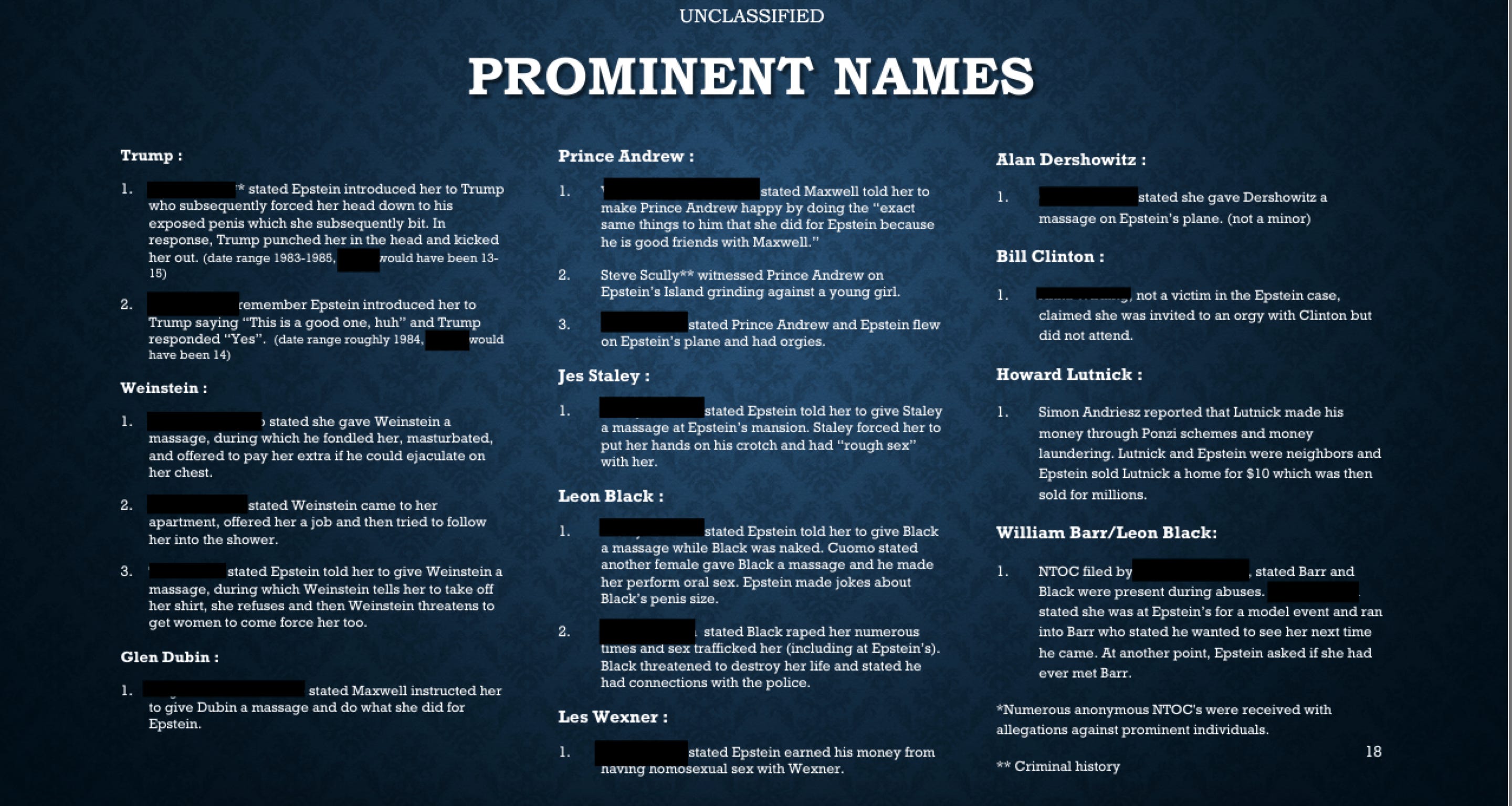
The second Trump claim on the slide — that Epstein introduced a victim to Trump when she was 14 years old, saying, “This is a good one, right?”, to which Trump agreed — carries immense credibility within the DOJ: That claim, about an incident at Trump’s Mar-a-Lago club in 1994, came from a key government witness whose testimony at trial helped DOJ prosecutors convict Maxwell, the files reveal.
Both the presentation and the email chain were created last summer, around the time Deputy Attorney General Todd Blanche interviewed Maxwell for an anachronistic jailhouse proffer.
The assault allegation initially came via a lead called into an FBI hotline, according to internal records about the hotline tips. The Trump accusation sits at the top of that list, which also contains salacious, unverified, and often bizarre accusations against Trump. The notes show the FBI followed up on the tip, learning the victim’s identity from the caller and preparing to dispatch agents to the “Washington Office” for an interview.
But the slideshow presentation and the internal emails last summer don’t cite the hotline as the source for the tip, as they do for a tip about Bill Barr. Instead, both cite the victim herself as the source of the claim, showing the FBI spoke directly with the Trump accuser. (Elsewhere on the slide, a claim about former President Bill Clinton is attributed to someone specified as “not a victim.”)
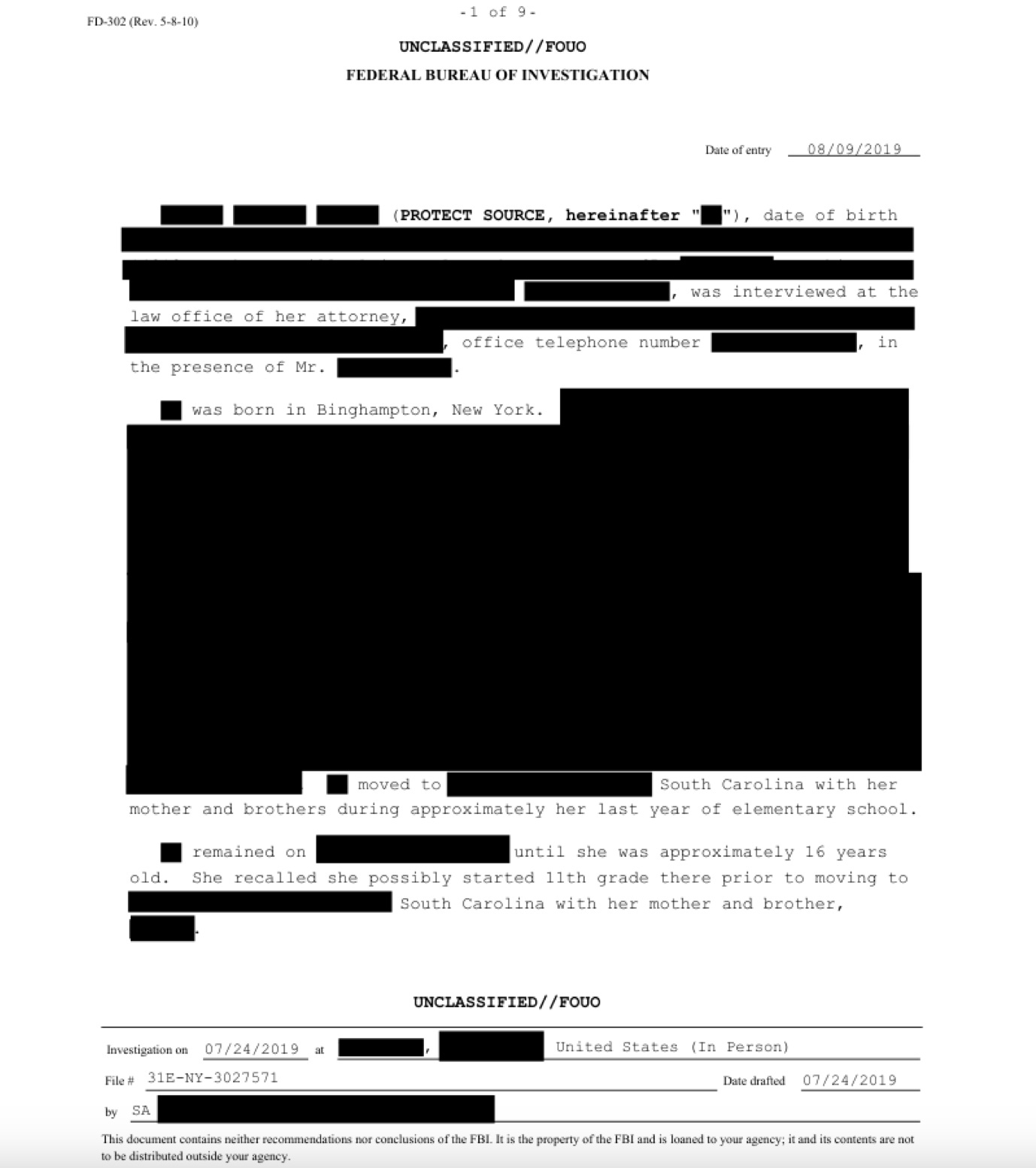
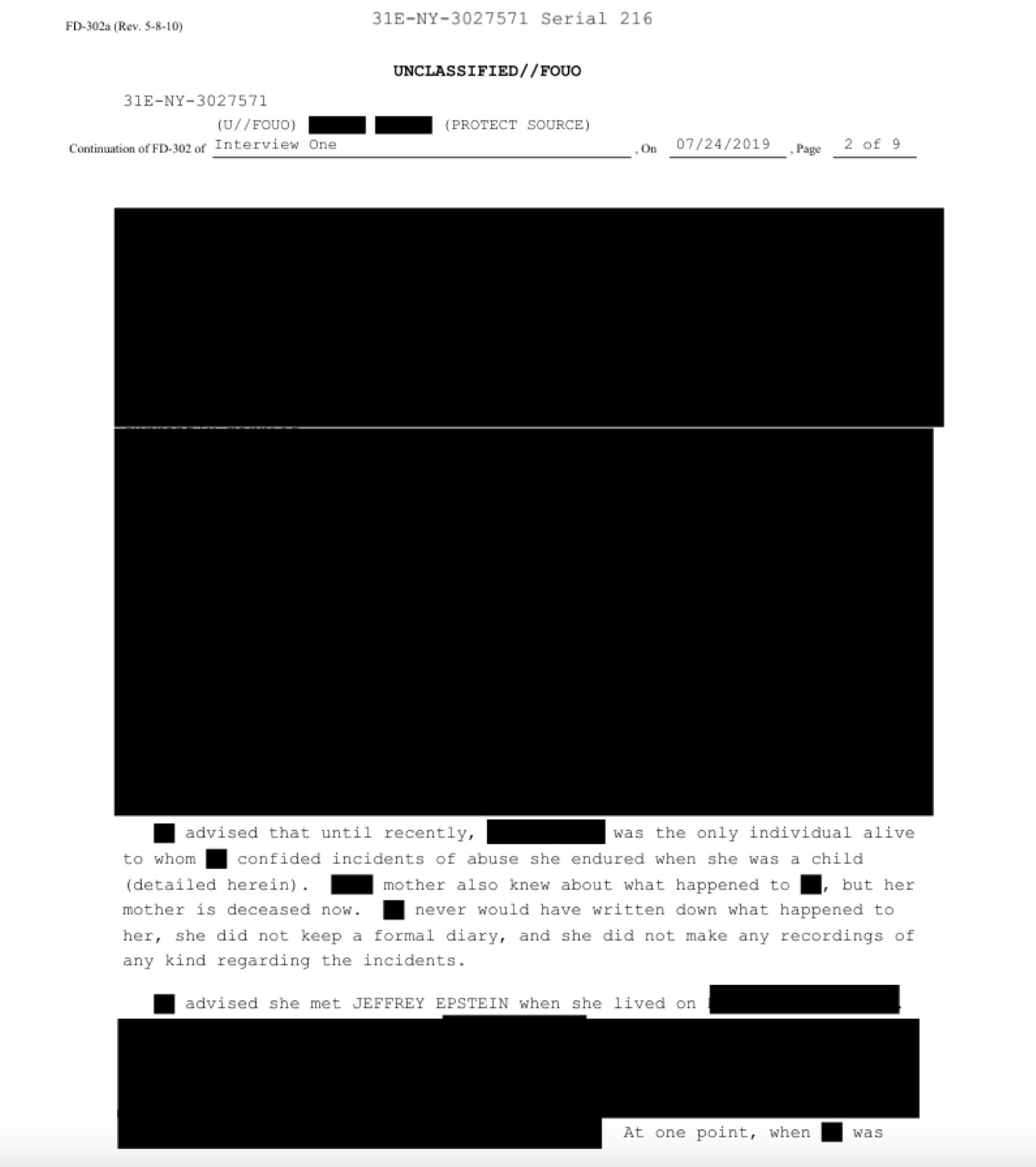
While it’s not clear what became of the investigation into the Trump claim, details from the tip match other records in the files, including an FBI writeup (known as a “302” form) of an interview with an Esptein victim and her lawyer. The interview was conducted July 24, 2019, and entered into the FBI’s case files on August 9, the day before Epstein was found dead in his jail cell.
The first two pages of the interview feature redacted blocks of text.
Later in the interview, the woman discussed a photo of Epstein and Trump that someone had sent her, which was still saved in her phone. The victim asked the agents if she could crop someone out of the picture — Donald Trump. When the FBI agents asked if she could explain why she wanted to crop Trump out, the woman hesitated, and her attorney answered, saying “[REDACTED] was concerned about implicating additional individuals, and specifically any that were well known, due to fear of retaliation,” the 302 says.
”Of note, the particular image sent to her by was recognized by Agents as a widely distributed photograph of JEFFREY EPSTEIN and current United States President DONALD TRUMP,” the 302 says.
Epstein database searches for this victim’s case number — 3501.045 — turn up other affiliated documents, including a July 19, 2019, memo showing the FBI’s Seattle, Washington, field office handled the interview.
The woman’s Epstein “victimization occurred in the 1980’s when the caller was approximately 13 to 15 years old and resided in the [REDACTED] Island area of South Carolina. The reported victim provided enough preliminary information to warrant a follow-up interview,” the memo says.
Those biographical details match the initial tip, which notes a criminal history in South Carolina. They also match public reporting about a South Carolina victim relocated to Vancouver, WA — close to Seattle — who filed a lawsuit against Epstein, receiving a settlement from his estate in 2021.
According to reports about the lawsuit, the victim claimed she had also been assaulted and raped by “other prominent, wealthy men” she met in other states, most specifically when Epstein took her to “intimate gatherings” in New York City. The alleged sexual and violent assault at Trump’s hands took place in New Jersey, according to FBI notes.
The woman’s reported settlement with the Epstein estate came despite a seeming paucity of hard evidence to support her claims. The 302 notes that the victim said she “never would have written down what happened to her,” only told two people about the abuse — one of whom, her mother, had passed away — and “did not keep a formal diary, and she did not make any recordings of any kind regarding the incidents.”
There’s also a seeming paucity of information about this victim in the Esptein files. Searches for the victim’s case number pull up some records — including the cropped photo of Epstein mentioned in the 302 — but some gaps appear in the FBI’s ordinal record-keeping of the files.
A master Epstein evidence manifest shows the government “acquired” at least four pieces of evidence in late February and March of last year—around the time the DOJ was conducting its initial all-hands review of Epstein records, and around the time the DOJ was returning to Trump troves of sensitive government documents he took with him to Mar-a-Lago upon leaving office in 2021.
I’ve reached out to a DOJ spokesperson for comment, and will update this piece with any response.
So far, Trump — thanks in part to false statements, misdirection, public confusion, and excessive redactions from his own DOJ — has evaded the crosshairs of credible allegations in the Epstein files.
However, this claim would contradict the narrative that the sitting president has not been credibly accused of wrongdoing in the Epstein saga.
The second claim against Trump on the slide — that “Epstein introduced [a victim] to Trump saying ‘This is a good one, huh’ and Trump responded ‘Yes’” — would appear to carry substantial credibility within the DOJ, because it came from an Epstein-Maxwell victim whose testimony helped the government convict Maxwell at trial.
A separate internal DOJ email about allegations involving Maxwell victims and prominent figures dated around the same time — July 22, 2025, days before Blanche’s jailhouse interview — includes this allegation, noting the victim “testified at trial.” The encounter occurred at Trump’s resort compound at Mar-a-Lago when the victim was 14 or 15 years old, the email states. That matches a claim in handwritten notes from 2019, where the victim recounts over several pages her traumatic history with Epstein and Maxwell. The encounter with Trump occurred around 1994-1995, the notes say.
“This is my friend [REDACTED],” the notes say about what Epstein said at the time. “Think he said friend.”
With the help of allies in Congress and the media, Trump has bulled through dozens of allegations of sexual misconduct, emerging with little political damage. But the courts have delivered significant verdicts against him: In 2023 and 2024, juries in New York found Trump liable for sexually abusing and defaming writer E. Jean Carroll, awarding her a total $88.3 million, then convicted him on 34 felony counts for fraudulently disguising payments to buy the silence of adult film star Stormy Daniels ahead of the 2016 election, weeks after leaked Access Hollywood footage revealed Trump bragging in 2005 about assaulting women “by the pussy” without fear of consequences.
While this Maxwell witness says she was not a victim of Trump, she does meaningfully undermine one of the president’s central defenses — that despite years of close friendship and socializing, Trump had not been aware that Epstein preyed on underage girls and cut ties with him once he did learn about it. Maria Farmer, an Epstein and Maxwell victim and the sister of Annie Farmer, another key witness against Maxwell, says she told the FBI twice to look into the now-dead predator’s ties to the president, in 2006 and 1996.
The 1994 Mar-a-Lago encounter with the 14-year-old came two years before Farmer’s first tip and at least a decade before Trump claims to have kicked Epstein out of his club “for being a creep,” as the White House has maintained in statements for months.
The claim adds to a growing pile of information challenging what Trump knew about his dead friend’s history of abusing and raping young women, and when he knew it. That evidence includes a lewd birthday card Trump sent Epstein in 2003, the long and deeply reported history of their socializing in the 1980s and 90s, a fully redacted email between Epstein and Maxwell discussing Epstein and Trump’s relationship, and an FBI interview with Palm Beach chief of police Michael Reiter, who said Trump told him in a 2006 phone call that Epstein’s disgusting behavior was widely known and Maxwell was “evil.”
Asked about that call last week, the White House wouldn’t confirm or deny that it occurred.
“Thank goodness you’re stopping him, everyone has known he’s been doing this,” Reiter recalled Trump saying. The chief also recalled Trump claiming he’d once encountered Epstein around a group of teenagers and “got the hell out of there.”